



Here is information about pricing, deliverables, timelines, and ethical considerations. You can find this information and more in the free white paper, “How to Work With a Marketing Researcher.”
How much does research cost?
By the hour or by the project. The researcher may prefer to be paid by the hour and state her hourly rate. However, you may prefer to know the total cost of the project before you commit. Don’t be afraid to ask for a flat price. Probably you will ultimately agree on a project cost, with any other services beyond the basic project to be paid for at the hourly rate. The contract should include a detailed project plan, so you know the scope of the project.
How much to pay. Whether you pay by the hour or by the project, prices for marketing research will vary widely, due to many factors. Every study is different, requiring different methods, expertise, and possibly equipment. That makes sense, right? You can imagine that a taste test conducted in a test kitchen would be more costly than conducting a simple online survey. However, even surveys can get expensive if you are trying to reach a sample that is hard to access, for example, people in ill health or people without Internet. Hourly rates may run $75 to $150. Day rates range from $500 to over $1,500 depending on the task. Per project rates can start at $200 for a set of survey questions to well over $100,000 for a series of focus groups conducted in multiple countries and languages. To give you an accurate estimate, the researcher will need to ask you many questions. In most cases, you can negotiate with the researcher to reach a mutually agreeable amount and payment process.
Do it yourself. As a die-hard DIY fan, I love to encourage people to consider taking charge of their own marketing research. Don’t be afraid to consider doing some of the research tasks yourself. The independent researcher may be more open to this idea than your account rep at the full-service research firm, but it doesn’t hurt to ask. Remember, your objective is to gather data that is relevant and useful to you. If you are comfortable analyzing your own data, you can save a lot of money.
A simple 10-question online survey emailed to your 50 best customers can give you actionable data for almost nothing, if you use an online survey platform such as Survey Monkey, Survey Gizmo, or AYTM. If you use your own email list, it’s free. If you let the survey provider pull a sample of respondents, you can pay as little as $1.00 per completed survey. If you need more than 10 questions, you can subscribe to the service for monthly or annual fees. If you really want to have some fun, consider using Google Forms, which as of this writing is free and allows unlimited questions.
There are two main types of research: qualitative and quantitative. I’ll discuss them briefly here in the context of pricing.
Qualitative research. Some types of research involve talking to people face-to-face, via chat or Skype, or on the telephone to gather responses in the participants’ own words. This is called qualitative research and produces textual data, or sometimes image data. These interviews can be with one person at a time or with a group of 6-10 people (commonly known as a focus group). After renting a location, hiring a moderator, and recruiting a sample, one in-person focus group could cost you from $5,000 to $20,000. If your customers are scattered around the globe, an online focus group might be an option. Conducting online interviews and focus groups requires a reliable Web conferencing platform, the prices of which vary depending on the tools you require (e.g., chat and instant messaging, streaming video, and screen sharing). Then again, an informal round-table discussion with some of your best customers in your conference room could cost you little more than the price of pizza.
Quantitative research. The other type of research is quantitative research, which produces numbers that we can summarize, count, and compare. Quantitative research typically involves distributing questionnaires to potential respondents usually via email or from a link on a website. Instead of gather-ing participants’ actual words, we give them survey questions. They click boxes and buttons to indicate their opinions. These surveys can include qualitative “open-ended” questions, in which respondents type their responses. Surveys can also be conducted by a telephone interviewer or distributed by mail.
Online surveys are familiar to most Internet users. Not everyone likes online surveys. Not everyone you approach with an invitation will be willing to participate in your survey (no matter how fascinating we think it is!). You might have to send out a lot of email invitations (and reminders) before you get enough responses to perform statistical analysis on the data.
In general, an online survey can be conducted for $3,000 to $10,000, including design, questionnaire, data collection, data analysis, and reporting. The price is affected by how difficult it is to reach the desired sample. To survey members of a hard-to-reach group like executives, you may spend $10 or more per participant just on recruiting costs. If you are targeting your own customer list, the recruiting cost per participant is virtually free.
The variety of available methods can be overwhelming. Your objective is to gather the data that will help you reduce uncertainty and make informed and effective business decisions. That doesn’t mean you must spend a fortune on research. But you shouldn’t opt for the least expensive method if it won’t provide you with actionable data. This is where your researcher becomes your trusted partner. A good researcher will ask a lot of questions, listen to your answers, and then make thoughtful recommendations, based on a comprehensive review of your situation.
Set up milestones. How and when you pay for your research project depends on size: your size, the size of the researcher’s company, and the size of the project. If you are with a large company, you probably have procedures for contracting and paying vendors. You may need to get a purchase order number for each project you commission. You probably sign off on the invoice your researcher sends you after the project is complete, and if the researcher is lucky, 30 days or so later, she may see a check from your company in her mailbox. If you are a small company or a marketing consultant, your procedures may be a lot less structured. If you choose to work with a large, well-established research firm, they will be the ones with the structured processes. They will bill you in increments after certain delivery milestones, and you will have 30 days to pay their bill. If you are a consultant and you choose to work with a research consultant, then you are free to mutually devise payment and delivery milestones that suit you both. Typical milestones might be as follows:
- Deposit to begin
- Partial payment after approval of research design
- Partial payment after approval of the question set
- Partial payment after data collection
- Partial payment after data analysis
- Final payment after completion of project
If there are costs incurred with outside vendors, such as for recruiting the sample or hiring a focus group facility, you will be responsible for paying those costs yourself.
How long does research take?
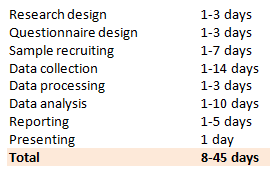 Again, the turnaround time of a research project depends on the project. If you commission just a set of questions for some focus groups you plan to conduct yourself, you might receive a first draft within several hours and be able to finalize the questions the next day. On the other hand, if you commission an online survey, you can expect the process to take somewhat longer. Here are some estimated turnaround times for a simple online survey (15 questions, 100 responses).
With new technology, researchers are speeding up the entire research process. The research phases begin to overlap: sample recruiting overlaps with data collection, which overlaps with data processing and analysis. You can start seeing your results in less than a week. This agile approach can be great when you need your data fast. Go to Google and search for agile research to find the firms that provide this accelerated service.
[Why fast is not always better]
What do I get for my money?
You should expect certain outcomes from your research project. First, I’ll talk about deliverables, and then I’ll discuss some of the intangible returns from research.
Deliverables. You can think of the deliverables you receive from the researcher on a continuum, from barely more than DIY to ongoing advice from a trusted research partner for life.
When you use an online survey platform like Survey Monkey or AYTM, all of the “magic” happens behind the scenes. The data are collected electronically. The calculations happen invisibly, resulting in some nice looking charts and graphs. You can download the data itself in a spreadsheet to do your own analyses.
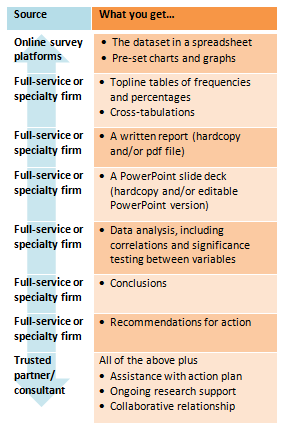 If you hire a consultant or a larger firm to do your project, you can expect to receive a lot more. One deliverable you will usually receive is a report of the responses received for each question, called a topline or an annotated questionnaire. These tables report the frequencies and percentages of the variables in the data. You may also receive a report consisting of “contingency” tables, or cross-tabulations (for example, how many men purchased, compared to how many women purchased). In addition to the topline report and a cross-tab report, you will most likely receive a full written report, which will usually present some analyses of the data (illustrated with charts and graphs), some conclusions drawn from the data, and some recommendations that follow from the conclusions.
If your project was qualitative, the report should include a summary of the themes that surfaced during the analysis, as well as the transcriptions of the interviews, minus any identifying personal information that might compromise the anonymity of each participant.
The depth of analyses in the final report may vary, depending on the researcher and the research problem being studied. Your responsibility is to make sure that the information in the report is relevant and useful to you, so review the first draft with care and make suggestions. The final report will most likely be a pdf file, not easily editable. After all, the researcher’s name will be on it, so his or her integrity is at stake.
You may also receive a deck of PowerPoint slides, useful if you plan to show the findings to your client or boss. The PowerPoint should be editable and synchronize with the written report.
Finally, you should expect some kind of presentation from the researcher, either in-person or via conference call or Skype. The researcher should lead you through the project, summarize the conclusions and recommendations, and answer your questions.
If all this seems great, but you aren’t sure you can afford it, fear not. You can sometimes negotiate a lower project price by foregoing the PowerPoint deck and presentation. You may not need much in the way of data analysis, if your data is best represented with simple tables.
Specialty research firms usually offer something specialized—for example, one data collection method or one statistical analysis tool. This means their collection, processing, analysis, and reporting processes may be highly standardized. In such cases, you will have little if any input into the report you receive. Make sure you understand up front exactly what you are buying.
Intangibles. Here’s where I make my pitch for the value of marketing research. Using our intuition (or gut instinct) can sometimes lead us where we want to go, but it can also lead us off a cliff. Some solid, relevant, timely data can give us insight and help us make informed decisions, so our businesses can be more successful.
Your marketing researcher can be a trusted partner in this process. You don’t have to develop a relationship with a researcher or with a research firm, but having the support and feedback of a researcher can make your marketing and business decisions more effective. A good researcher can help you understand what your data mean, offer recommendations for action, and even help you with those actions.
[How marketing research works]
What can go wrong?
Research is not an exact science. In addition, it is conducted with people, by people. Technology simplifies and speeds up the process, but in the end, the data are only as valid as the research participants and analysts are honest and truthful. Sometimes survey questions are confusing and poorly worded. Respondents don’t always answer truthfully. Researchers don’t catch everything, despite diligent efforts to proofread and pilot. Sadly, some researchers hurry the analysis process, making mistakes or missing important conclusions.
[How to fool people with charts and graphs]
Managing expectations. If you feel like you didn’t get what you paid for, go back to your agreement and make sure that everything the researcher promised you is delivered. Use the milestones to monitor the quality of the study. Before you make a milestone payment, make sure you are satisfied with the progress of the study.
If you feel like the results of the study didn’t help you answer your research problem, that is time to sit down with your researcher and talk about what happened. If you both agreed that the study addressed the research problem as it presented at the start of the study, then maybe something changed. Did a competitor launch a new product and skew your study results? External and internal events and conditions can affect the outcome of a study. Neither you nor the researcher can predict or control every variable. We all do the best we can.
Ethical guidelines
It’s easy to get carried away by the desire to conduct a survey and forget that people can be harmed in the process. Imagine how wrong a taste test could go if researchers and clients failed to follow some ethical guidelines.
Considerations for both you and the researcher include:
- Acknowledging each respondent’s right to be informed, to be treated with respect, and to refuse to participate
- Respecting the respondent’s privacy and anonymity
- Maintaining the confidentiality of the respondents’ data
- Behaving honestly with no intent to deceive respondents
- Avoiding mixing research with sales
- Avoiding spamming potential respondents with invitations to participate in research
- Respecting the data
Ethical considerations for you, the Client. Don’t withhold important information from the researcher, especially during the design phase of your study. Don’t make promises to pay what you cannot afford. Don’t ask for a discount on a pilot study that you claim will be the basis for future studies if you have no intention of actually doing future research. The worst thing you could do would be to intentionally misuse the findings from your study. This could involve stating conclusions that aren’t supported by the data. In other words, avoid the temptation to manipulate the data to misrepresent you, your company, or your product.
Ethical considerations for the researcher. The researcher should design research to assure reliability and validity of the data. The data collection, processing, and analysis processes should be transparent and open to the Client, with due regard for the confidentiality of respondents’ personal information. The researcher has a responsibility to report findings accurately. The researcher must keep the client’s information confidential. The researcher should report the definition of the population and describe the sample size, completion rates, and method of selection. The research method, location, and dates of data collection should also be stated. Finally, the researcher should avoid conflicts of interest between prospective clients.
For more information on the ethical pitfalls of marketing research, Google search using the terms “marketing research code of ethics.”
Note: Yes, that is a photo of a real, live Benson Bubbler drinking fountain.