



Small Business Warrior, owned by Christy Strauch, is a coaching firm based in Scottsdale, Arizona. The Small Business Warrior mission is to help small businesses “master the business of their life’s passion.” Christy’s clients come to her for help with business planning, guidance with financial issues, and advice to improve marketing and boost sales.

In August 2013, Christy wanted to find more clients similar to the ones she had. She decided to do a small customer insight survey to find out some basic characteristics of Small Business Warrior’s current clients.
Research questions
- Who are the clients of Small Business Warrior in terms of their product/service, age, gender, number of employees, and location?
- What business challenges do they face?
- Why did they hire Small Business Warrior?
- Where do they get information about sources to help them with their business planning and marketing planning?
- How did they find Small Business Warrior?
I prepared a survey using Google’s form program. Google forms is similar to the other survey programs available, such as Survey Monkey, SurveyPro, etc. However, Google forms, as of this writing, is free for an unlimited number of questions.
Christy emailed a link to the survey to her email client list. Sixteen responses were collected in the Google spreadsheet and analyzed using basic Excel functions. A sample of 16 people isn’t very many, I know. But the responses offered some insights that we didn’t have before. In other words, this study reduced Christy’s uncertainty about which of her marketing strategies might be most effective.
Sample
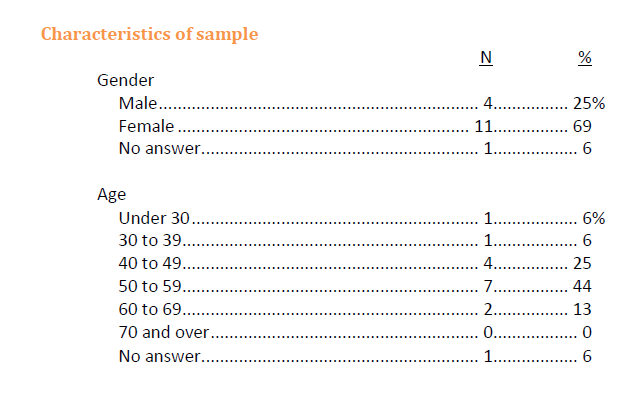 Most of the respondents in the sample were women (11 of 16). One person declined to answer the gender question. Seven of 16 were aged 50 to 59. It would be interesting to see if this proportion held true in a larger sample.

What three problems are you facing in your small business?
The respondents were asked “What three problems are you facing?” They typed their responses into three separate text boxes. As you can see, the first respondent entered more than one problem in the first box.
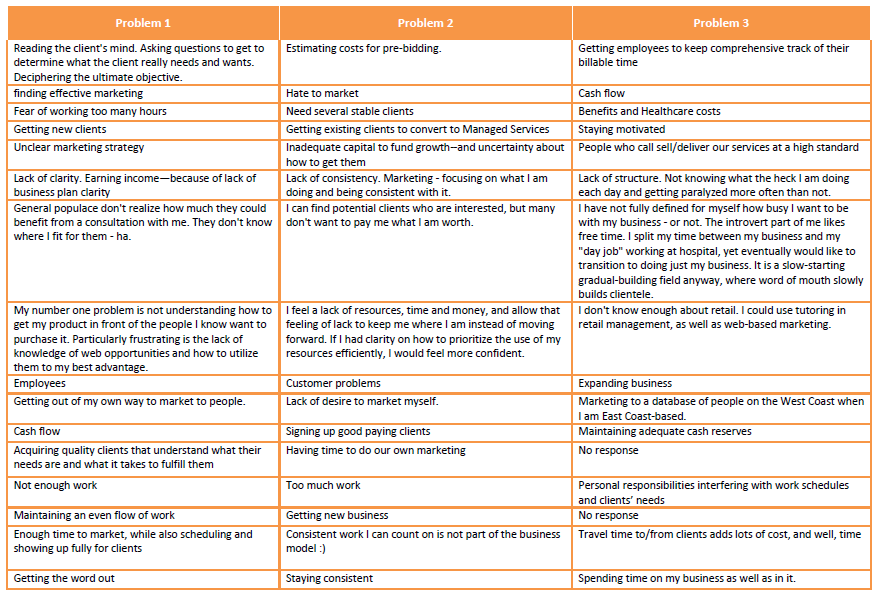 Raw responses, like the ones shown here, can offer a valuable peek inside the respondents’ minds. Ask a question like this before you ask them a more specific question, so you can gather their top-of-mind responses before they can be influenced by anything they might subsequently read in later questions. This is the so-called funnel technique of questionnaire design: ask the more general, open-ended questions on a topic first, and then follow up with more detailed and specific questions.
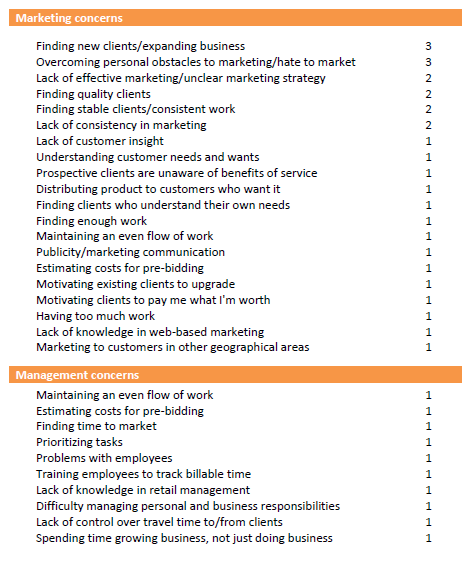 To gain more insight into the respondents’ perceived problems, I organized the entries into categories. Categories will often naturally emerge from qualitative data. There are many ways to categorize what people say. After exploring the data a bit, the categories that seemed to surface first were functional categories: marketing concerns, management concerns, finance concerns, structural concerns, personal concerns, and technology concerns.
The top marketing concerns were finding new clients, expanding business, and overcoming a dislike of marketing.
No one management concern stood out among the rest.
Cash flow was a concern.
Organizing the responses into these functional categories allowed us to identify the solutions that Small Business Warrior was already providing and uncover the solutions that could become future products and services.
The next question we asked was, “What motivated you to seek a business coach?” We were trying to identify the pain points, or triggers, that might prompt a small business owner to hire a coach.
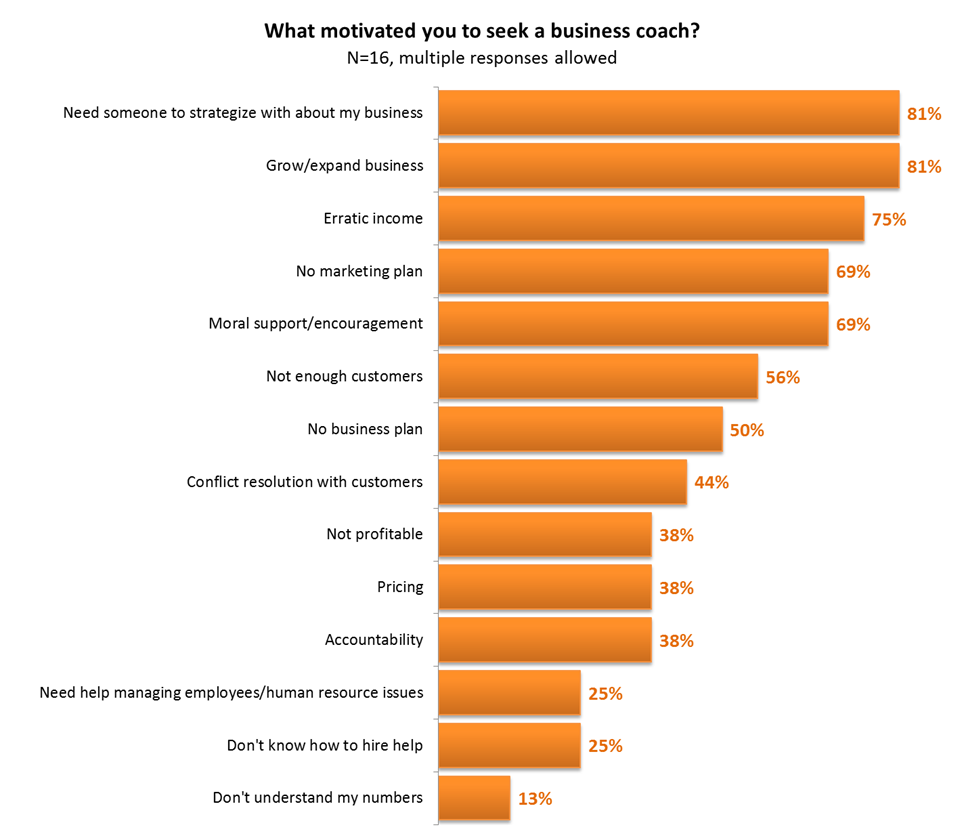
Question 3 was an aided follow-up to the unaided Question 2, to make sure we didn’t miss any reasons why a small business owner might seek to hire a business coach. Participants were allowed to choose multiple responses from a list of 14 reasons. The list was generated by collaborative discussion between researcher and client. Our survey did not provide an Other option for participants to add a reason we had not included in the list.
The top reasons for seeking the assistance of a business coach were Needing someone to strategize with about my business, and Grow/expand my business. Christy was surprised that more of the respondents weren’t interested in getting help figuring out their finances. If this pattern holds true for a larger sample of small business owners, Christy might consider shifting the focus of her business toward more strategy-related services and products, and away from financial services.
47 of the selected responses were marketing-related, 20 were finance-related, and the remaining 45 involved management issues with employees, customers, and self. Interestingly, the top three reasons spanned all three categories.
Further analysis of Question 3 revealed that six participants selected an above-average number of reasons from the list (8 or more reasons), and six participants selected a below-average number of reasons (fewer than 6 reasons). Four people selected 7 or 8 reasons (7 was the average of the sample). I wondered if any interesting differences could be detected between the “above-average” Group A and the “below-average” Group B.
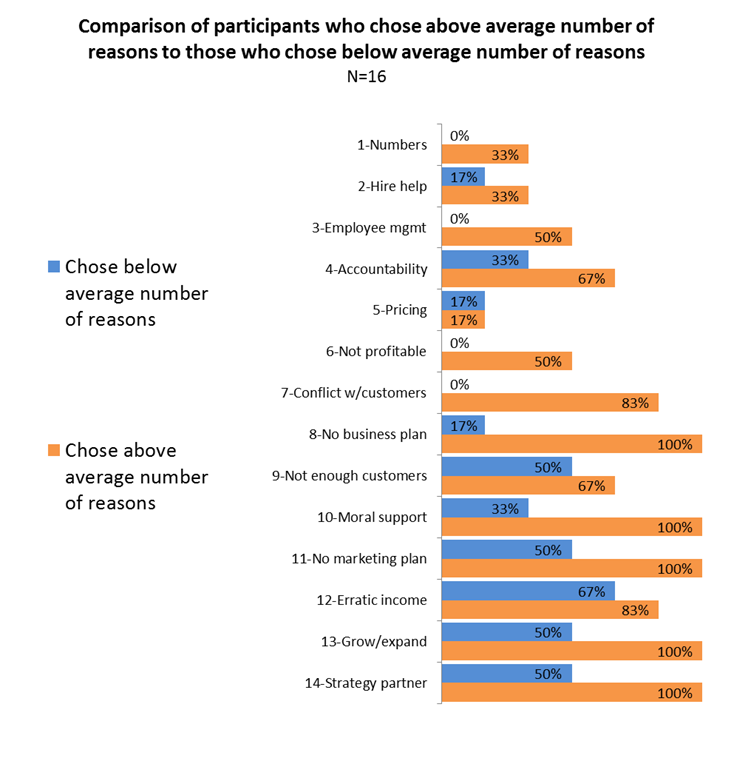 Group A selected a larger than average number of reasons to choose a coach and seemed to be especially interested in needing support and being held accountable. They were more likely than their below-average counterparts to need help with their numbers. They were much more likely to have conflicts with customers, to express a need for a business plan and a marketing plan, and to believe they needed to grow their businesses.
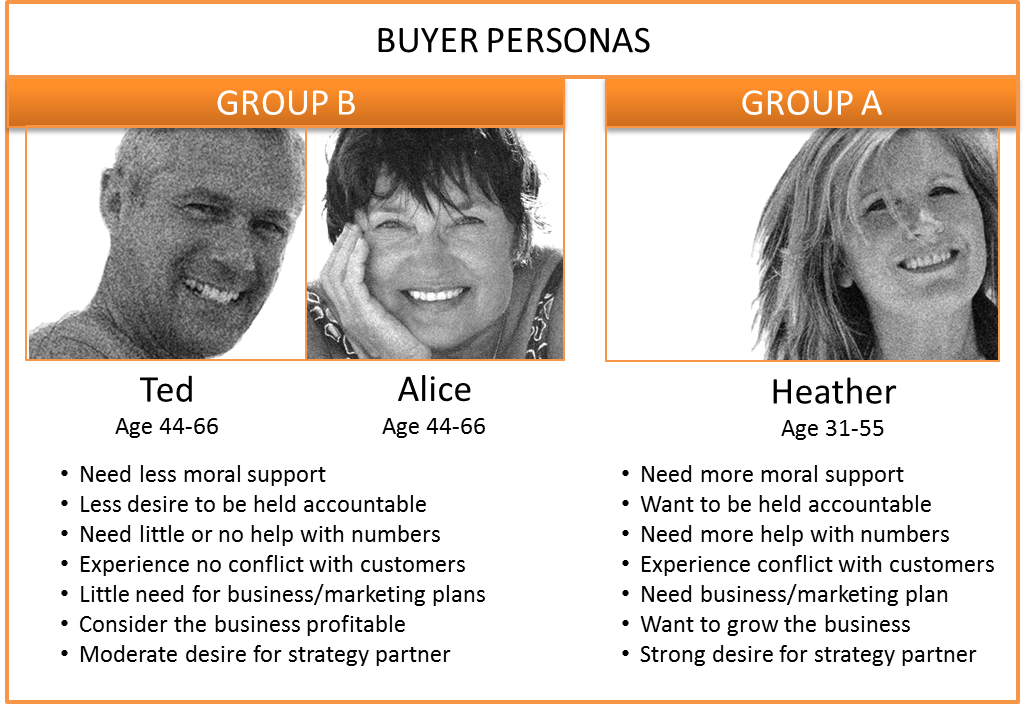 On the other hand, the participants in Group B chose fewer reasons to hire a coach and seemed to have no trouble with their numbers, didn’t appear to consider themselves unprofitable, reported no conflicts with customers, and were much less likely to seek moral support. They were much less likely to lack a business plan and somewhat less likely to lack a marketing plan. They were also less likely to have employees to manage.
Both groups expressed a belief that they needed more customers. Both groups reported dealing with erratic income, and both groups evinced an equal desire for help with pricing.
The sample size of 12 was very small, with six members in each group. However, based on a t-test between the two groups, there was a possibility that they were significantly different from one another (t = 2.365, df = 7.91, p < 0.001). Confirmation should be attempted with a larger sample. The finding, if confirmed, could point toward two client profiles, two markets with different needs.
These findings can be correlated with other data, such as profitability and personality assessments, to discover if one group merits more attention than the other.
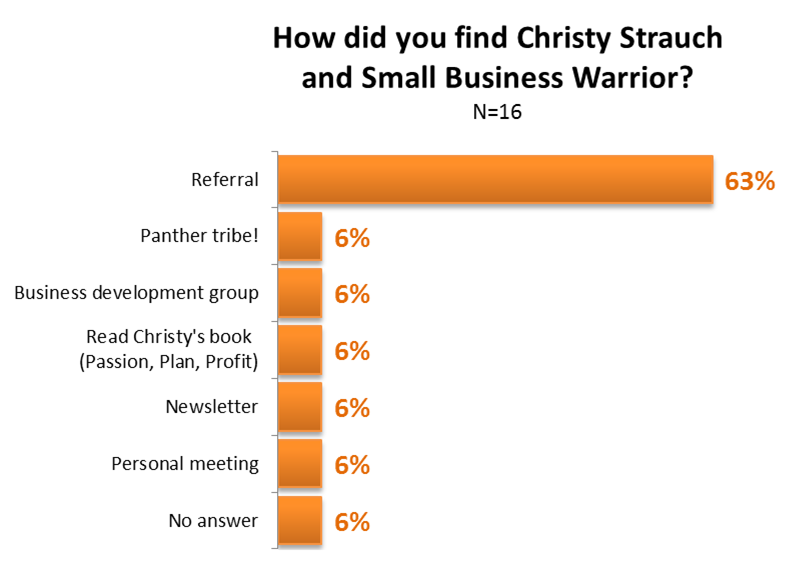
How did you find Small Business Warrior?
Respondents were asked how they found Christy and her business. Ten of the 16 participants found Small Business Warrior through referrals. The question did not probe the type of referrals. The other participants mentioned a business development group, Christy’s first book (Passion, Plan, Profit), the Small Business Warrior newsletter, and a personal meeting. One person mentioned Panther Tribe. One person declined to answer.
Some conclusions
Question 2. In response to this unaided question, many of these 16 participants noted challenges with marketing, operations, and finance. These three areas of concern closely match Small Business Warrior’s service offering. This might lead us to conclude that customers are not confused about the services offered by Small Business Warrior. Further, the fact that there were 28 marketing-related issues offered by the sample (more than any other category) seems to suggest that customers primarily seek assistance with marketing issues.
Question 3. Although customers might not have expressed confusion about the services offered by Small Business Warrior, they seemed confused about what they thought they needed. There seemed to be several latent reasons for hiring a business coach that didn’t occur to these participants until the reasons were offered in Question 3. The most salient reason to hire a coach was a desire to have someone to strategize with, although the lack of coaching was not perceived as a problem in the unaided question.
Question 4. Two participants (both female) expressed what sounded like gratitude that Christy took action to contact (pursue) their business. The implication is that small business owners who struggle with their marketing may not be proactive in seeking the help of a coach. However, they might be receptive if the coach approached them. From the findings, it seems clear that there is a strong emotional element for these business owners. Working with a coach is possibly not like working with an accountant or a lawyer. Stressing the emotional support offered by Small Business Warrior could resonate with some small business owners, especially women.
Questions 8, 9, and 10. Demographic profiles of the two groups identified from Question 3 might indicate that Group A, the group that wants more attention, may be more likely to be female. This sample of six consisted of five females and one male, while Group B, the group that wanted less attention, was half female and half male. This sample isn’t large enough to say with any certainty that small business owners who need more attention are more likely to be female. To attract clients who need less attention (possibly these clients are more profitable?), you might consider marketing to attract male business owners rather than female business owners.
In addition, there is some evidence to suggest that there is an age gap between the two groups. Group A (needed above-average attention) averaged approximately 10 years younger than Group B (needed below-average attention), although one member of Group A declined to give her age.
Six of the sixteen participants were local to Arizona. None of the participants assigned to Group A (the people who need above-average support) were local to Arizona. Three of the six people in Group B were based in Arizona.
Again, the samples are very small. Use this information with caution.
Recommendations for future research
Explore what clients mean when they say they want “someone to strategize with about my business.” What specific services are they desiring? How will you know if you have successfully strategized? In other words, how will you measure success or failure? This exploration could be conducted informally by asking several clients the same question set.
###

SQMRC Note: Christy graciously allowed me to use her business as a pilot project. She is the author of three marketing books and gives frequent presentations to business owners in the Scottsdale/Phoenix area. She took the photos you see on this page. Yes, those are real birds.
From the results of this very small study, Christy gained insight into how her clients perceive her services. She discovered how prospects find her. She found out what her clients are worried about and what they expect from her. All of these insights can help direct Christy’s marketing strategy so she can maximize her resources and gain the best possible outcomes for her clients and for her business.
Would you like your business featured on my website? Send me an email or give me a call and let’s talk.